
Products · Concrete Technology · Nano-Concrete Technology
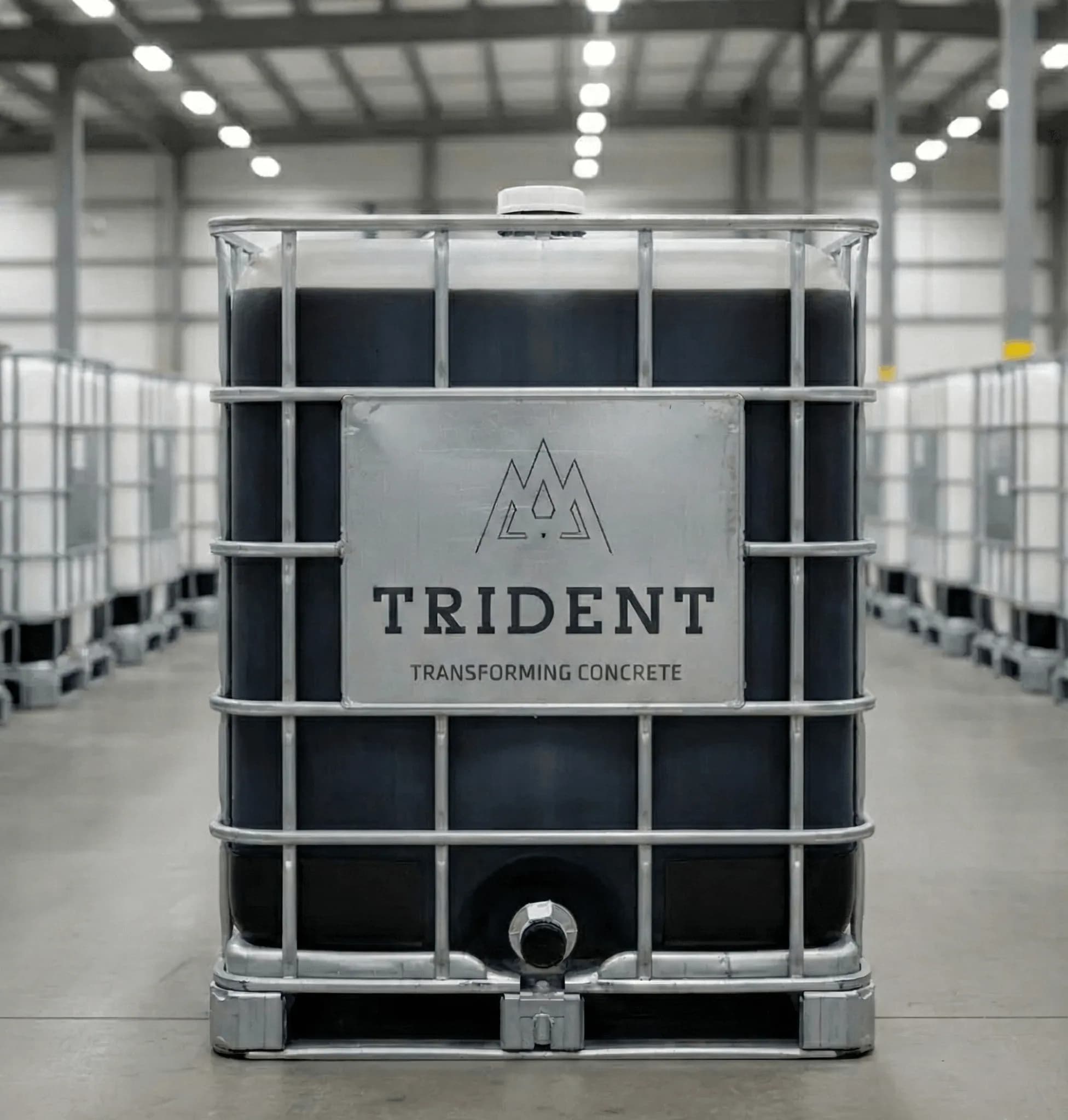
Flagship product
Trident
Nano-Concrete Technology
One liquid, dosed at the end of the mix cycle into the design you already run — and it recovers so much strength that a 50% slag mix reaches its 28-day strength in 7 days. Not an admixture: it lifts cement conversion from ~75–85% to 95%+.
- 28-day strength in 7 days at 1,200 g/m³ in every slag blend tested
- +2,850 PSI at 28 days — 40% over a poured control
- Up to 50% cement replaced with fly ash or slag, net of Trident ~18% off materials
Schedule or cost
28-day strength in 7 days.
In every slag blend tested at 1,200 g/m³, the 7-day break met the untreated mix's 28-day. In a producer's plant the mix finished 40% over its poured control at 28 days — +2,850 PSI — and reached that control's 28-day at 7. The 28-day number is what the spec accepts; the 7-day number is when the concrete can carry load.
Most producers will take some of each. The 8-hour precast result is a separate nucleation effect — not this maturity claim.
Ideal Testing & Consultancy · 1,200 g/m³ · original formulation (floor)
7
days to the control’s 28-day strength
Ideal Testing · every slag blend at 1,200 g/m³
Calendar to the same strength
Δ 21 days sooner · same strength threshold
Not a same-age comparison. Each pair below is control measured at 28 days vs Trident measured at 7 days — Trident already clears the later bar.
- 70% cement / 30% slag70/30
7d clears 28d control
Age
Strength · PSI
28d
Control waited
5,163 PSIPSI
7d
Trident measured
5,497 PSIPSI
Different ages on purpose — the point is schedule, not a same-day delta. Trident’s own 28-day (same dose): 7,121 PSI
- 60% cement / 40% slag60/40
7d clears 28d control
Age
Strength · PSI
28d
Control waited
5,903 PSIPSI
7d
Trident measured
6,324 PSIPSI
Different ages on purpose — the point is schedule, not a same-day delta. Trident’s own 28-day (same dose): 7,600 PSI
- 50% cement / 50% slag50/50
7d clears 28d control
Age
Strength · PSI
28d
Control waited
5,366 PSIPSI
7d
Trident measured
5,627 PSIPSI
Different ages on purpose — the point is schedule, not a same-day delta. Trident’s own 28-day (same dose): 7,571 PSI
The tradeoff
Spend the early strength once.
Day-7 strength that already clears the control’s 28-day gives you a choice: take time off the calendar, or keep the calendar and cut cement. Same dose either way — pick the value the project needs.
7
day strength
one dose · two spends
Spend on time
Keep the cement. Take three weeks back.
- Same mix design and cement content
- Accept strength at 7 days instead of 28
- Schedule owns the value
Sample spec clause
Accept compressive strength at 7 days equal to or greater than the specified 28-day strength for the control mix design.
Draft language for review with counsel. Not a quote. Adapt to the project specification.
Spend on cement
Keep the calendar. Cut the cement bill.
- Push SCM toward 50% replacement
- Hold the pour schedule and specified strength
- Cement (and GWP) own the value
Sample spec clause
Allow up to 50% cement replacement with approved SCM when Trident F-01 is dosed per manufacturer TDS; maintain the project’s specified 28-day strength and pour schedule.
Draft language for review with counsel. Not a quote. Adapt to the project specification.
You don’t stack both at full force on the same pour without checking the mix — early strength is the budget you allocate to schedule or to cement reduction.
Specifications
What you batch
The physical product and the dose. Strength numbers live in the trials.
What it is
- Form
- Liquid dispersion (black)
- Composition
- Modified nanomaterial in aqueous matrix
- pH
- 10–11
- Density
- ~8.5 lb/gal
- VOC
- 0 lb/gal
- Chloride
- 0.001 (BS EN 480-10:2009)
How you dose it
- Standard dosage
- 18 oz/yd³–46 oz/yd³
- When
- End of the mix cycle
- Mixing after dose
- 3–5 minutes
- Validated up to
- 12,000 PSI mixes
No capex. No change to slump, set, air, or curing. Compatible with Type C and F fly ash, GGBS, calcined clay, and many PCE superplasticizers — check the package before you batch.
Already on the plant
- Aggregates
- Cement / SCM
- Water
- Existing admixture
- ↓ into mixer · end of cycle
Trident F-01
Existing admixture line · 3–5 min mix after dose
No new equipment
Schematic of dosing order only — not a depiction of any customer plant.
Trial evidence
Three trials. Full tables on Results.
The homepage case studies in short form. Each card opens the dataset, including poured-control cylinders and the GGBS dose series.
Before you trial it
The three questions that decide it
Plant
Dosage, compatibility & documents
What a QC lab needs before Trident goes on a submittal. Applications and approvals live on their own pages.
Compatibility
- Fly ash C & F
- GGBS / slag
- Calcined clay
- PCE SP
- Air entrainers
- Fly ash Type C and F — up to 50% replacement
- GGBS / slag — up to 50% replacement
- Calcined clay — up to 50% replacement
What the plant changes
Nothing in the plant, the trucks, or the forms. One liquid, dosed off the existing admixture line at the end of the mix cycle. Ready-mix, precast, structural, and high-SCM work all run the same way.
See where producers use itFAQ
Questions producers ask before they dose
Dosage, strength, compatibility, and how to validate before you commit.
Is Trident just another admixture?
No. Trident is Nano-Concrete Technology — modified nanomaterials in liquid form that work at the microstructural level. It is not a chemical accelerator and not a mix-design change. Unlike past dispersed carbon-nanotube approaches in concrete, which failed on dispersion and cost, Trident is engineered for stable liquid dosing and provides additional nucleation sites for C-S-H crystal formation, lifting cement conversion from ~75–85% to 95%+.
Will Trident change my mix design or batching process?
No. Trident is a liquid dosed at 18 oz/yd³–46 oz/yd³ at the end of your normal mix cycle, with 3–5 minutes of mixing after dosing. It requires zero equipment changes and has no impact on slump, setting time, air content, or curing.
Is Trident compatible with SCMs and other admixtures?
Yes. Trident is compatible with Type C and Type F fly ash, GGBS/slag, and calcined clay at up to 50% cement replacement, as well as many PCE superplasticizers and air-entraining agents. Trident is sensitive to pre-blended PCE superplasticizers with secondary chemistries — tell us your admixture package and we'll check it against our compatibility data before you batch.
What strength gains should I expect?
Producer and lab testing shows +2,850 PSI at 28 days — 40% over a poured control — and 20–30% early strength gain within 24 hours. In precast trials, 8-hour strength improved by 159%. Actual results vary by mix design, cementitious content, and SCM blend.
How does Trident save money?
At modest SCM replacement (20→40%), Trident nets about 4–7% on materials cost. At 50% slag or fly ash replacement, net savings reach roughly 18% — about $16/yd³ at representative 2026 U.S. ready-mix prices — because strength gain grows as SCM content rises. Savings depend on local cement and SCM pricing; we run the model on your prices before a pilot.
Is Trident safe to handle?
Trident is a liquid dispersion with a pH of 10–11 and zero VOC content, handled like a standard liquid admixture. The SDS with full handling guidance is available for download on this page.
How can we validate Trident before committing?
Through a 30–60 day pilot program: we supply Trident, free samples, and complete R&D support, and you run the trial with your own materials in your own plant. Zero capital investment and no commitment until you've seen the results.